


From Desire to Awakening: The Process of Integration
By embracing the stigma that makes us different, we find community that makes us similar

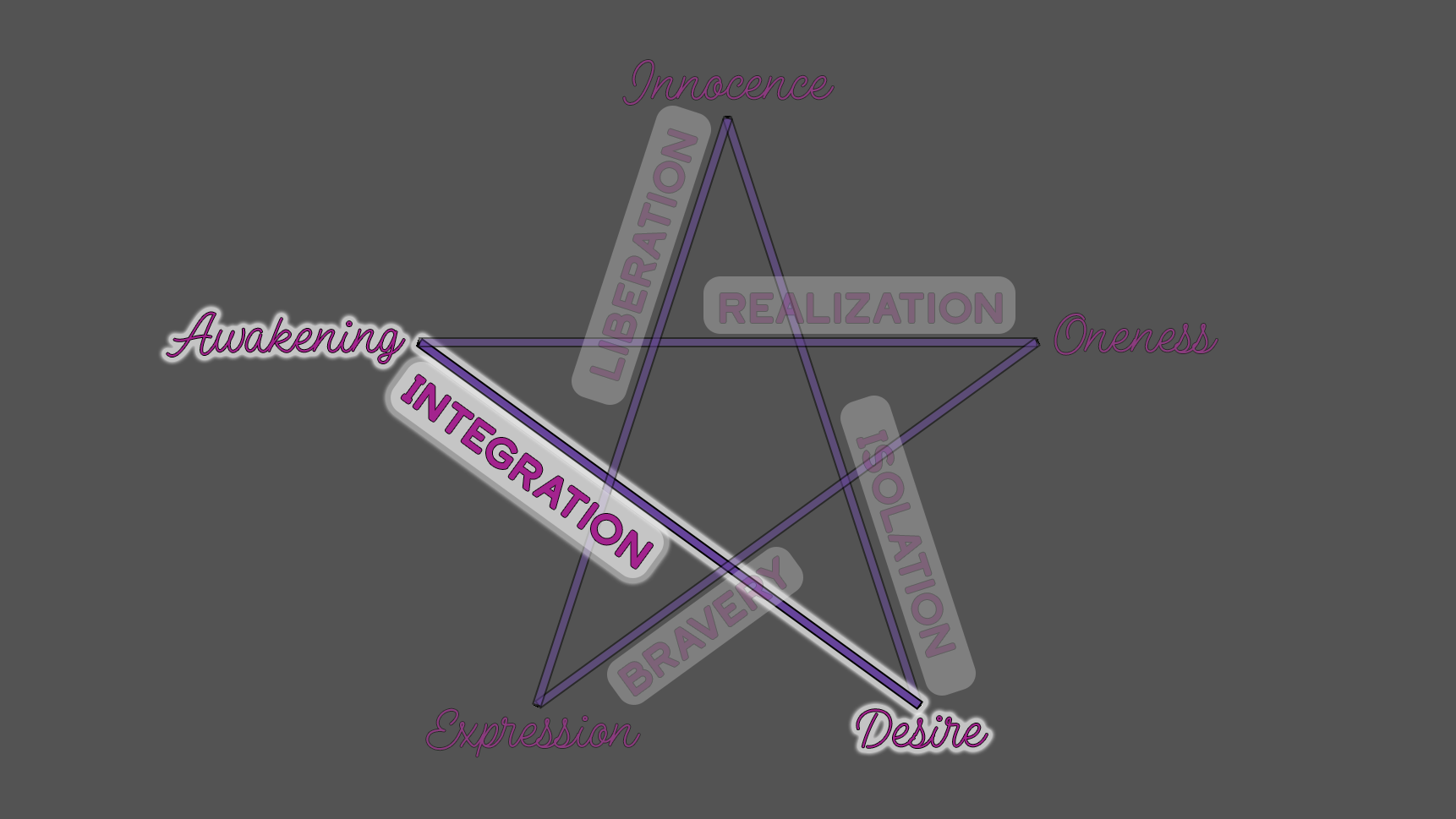
The Amethyst Pentacle models identity as five states of human experience connected by five processes in an unbroken cycle of discovery and growth. The last article examined how the state of Innocence fractures as we learn how we differ from the rest of the world.
We are confronted with social norms we cannot fulfill, and Isolation occurs as we accept guilt for our failures. We face a choice: abandon our values or embrace our stigma.
Desire is the state in which we begin to judge the stigma applied to us. Is it wrong to value what we do? Do we deserve shame and guilt for the difference between us and the rest of the world? Would it be better to recant what we value?
For now, we cannot answer those questions. Instead, we must know more about our stigma. We must understand not only what draws us to it, but also why social norms proscribe it from us.
The gap between us and the rest of the world is enticing. If we fill the gap of Desire with knowledge, will we salve the pain of losing our Innocence?
From Isolation, we reach out for community.
The Thirst for Knowledge
Every parent knows telling a child not to act a certain way glamorizes the behavior in the child's mind. When we cannot have what we want, the pull toward the taboo grows inescapable.
In our minds, we wonder, we ruminate, we rationalize. Could what we want really be that bad? How could something as innocent as the object of our desire possibly be taboo?
From Shakespeare to Yarros, the theme of forbidden love permeates the human experience. Is it any wonder that discovering a stigma stirs the cauldron of Desire?
As Erving Goffman writes in Stigma, the first phase of stigmatization is learning the behavior accepted by the social environment. But the second phase is playing out scenarios in which we embrace our possible stigma. The second phase begins with Desire to know more, to determine whether what we want is worth fighting our social environment to get.
Maybe knowledge comes in the form of an internet search. Maybe we seek out a trusted elder or mentor. Maybe understanding our Desire becomes a lifelong research project (including a midlife career change to write about it).
But Fate is inexorable. If we do not learn more, Desire will burn ever more brightly, inevitably overtaking us in the end. Could we ignore the stigma and learn to live without? Or do we immerse ourselves in taboo and swim the warm waters of sins of the human experience?
The Moment of Choice
We don't have to answer the questions we face. We could stop here. We could remain in a state of Desire: longing for release, perhaps understanding what release means for the future, but holding our will in check. A third choice, however, exists in our attempt to reconcile the stigma we yearn to express within the social environment rapidly losing its ability to contain us.
The third choice is to find another social environment that does not hold our Desire as taboo.
We can critically evaluate whether we ever truly belonged in our social environment, or whether we simply played along, biding our time until escape was imminent. Perhaps our initial social environment perceives a substantive difference in us, but how important is their judgment compared to our values?
If social norms exist in order to perpetuate a social environment, let them have their social norms. We have important work to do elsewhere. We have no need to rail against perennial correction when we can simply leave.
We stand at a precipice. Desire is not action. Judgment may be swift. Our values may not be worth the risk.
But now it is our turn to pass judgment - this time on the social environment. It requires great strength to abandon what we know to leap into the unknown. It requires the process of Integration.
Integrating Desire through Identity
The state of Desire is fulfilled through the process of Integration. Isolation from one social environment transmutes into identity within another.
The process of Integration could be as simple as learning a label. Whether the label is "transgender," "neurodiverse," "Pagan," or "artistic," knowing a word exists to describe what we feel implies others feel it, too.
Labels can be as harmful as they are helpful, but labeling Desire means we are not alone any longer. A label integrates who we are into a concept shared by others.
Can we find this community? Will they accept us? Now we can turn Desire into action. Now Desire for knowledge can become the experience of wisdom.
Before, we stood alone in the stark spotlight of judgment. Having executed our own judgment, we now stand supported by others. Regardless of whether the group is unpopular, at least we need not face reality friendless.
Awakening to a Greater Reality
Feeling thirst to understand, we seek the experiences of others. Perhaps we find a community that welcomes us with open arms. Perhaps we find discomfort in the company of others ejected through stigma. And perhaps still we mourn our Innocence.
But often, simply knowing others share our ideals is enough. Finding others who value what we do, gaze upon our experience, and cry "Yes!" in unconditional support fuels our further work within the Amethyst Pentacle. With their scaffolding, we begin to rebuild who we are in another social environment.
Isolation forced us to confront our essential differences, but Integration affirmed our differences are only substantive in some social environments. There are others who live fulfilling lives with precisely the stigma assigned to us through the loss of Innocence.
Desire chafes our minds until we possess the information to pass judgment, and our fall from many to one promises Integration back into many. Now we must discover the truth of our Desire.
We enter the next state of human experience. We open our eyes to Awakening.
The views and opinions expressed are those of the authors and do not necessarily reflect the offical policy or position of The Purplepaw Clan, LLC. Please view the Disclaimer page for further information.